
Looking Back on the js13kGames Feedback
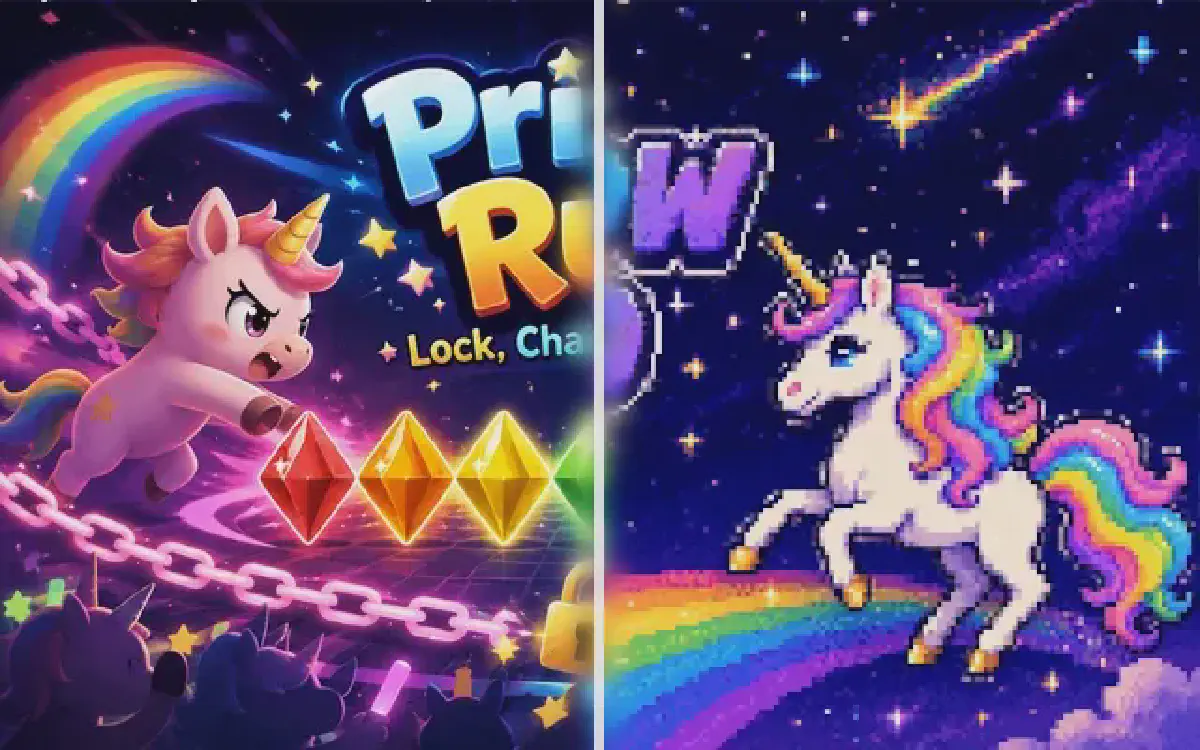
Hello, this is Yuu!
The voting period started on September 14, and so far I’ve received 20 pieces of feedback across the two games. That’s ten each for Rainbow Speed and Prism Rush, and both include one comment from an expert. Thank you again to everyone who left feedback.
I actually started writing this post last week and ended up rewriting it. I feel like I spent a bit too much time on replies, both to comments on my own games and to other people’s entries. That said, there was a lot to take away from each individual piece of feedback, and rereading them made the gap between what I had designed at the time and what actually came back quite clear. I’d like to go through it game by game.
Rainbow Speed: A UI Problem, Not a Difficulty One
Three comments said, in one way or another, that it took a while to understand the jump.
Two of them went on to say that they enjoyed it once they got it, and one of those rated the balance between hard and easy as just right. The remaining one was a straightforward question: why does the double jump only work sometimes?
And one person named the cause outright. The jump counter was outside their field of view, so they hadn’t noticed it, and they suggested placing it a bit higher. They also wrote that it helped a lot once they did notice it.
Air jumps work like ammo tied to the level, and they’re restored by landing on a cloud. So it wasn’t that the design failed to come across. The number showing how many were left simply wasn’t visible. What was being pointed out wasn’t the difficulty but where the information was placed. And on top of that, this is the kind of thing I can fix using almost no extra bytes.
Rainbow Speed: A Way to Play I Hadn’t Designed
The comment that made me think the most came from Dion van Beelen, one of the experts.
The gist was this: the premise looks simple at first, but accelerating every time you reach a cloud makes the next run something else entirely. Timing and managing the gaps between jumps also seems easy at first, but it gets harder as your speed rises and the number of jumps goes up. The small jumps become extremely small, so you have to be careful not to overshoot when trying to clear two gaps at once. The further you get, the more each run becomes a new challenge, which keeps it interesting and rewarding for a long time.
I had only designed half of that.
The theme of this game is “growth”: clouds you couldn’t reach at first become easy to clear as your speed goes up. I was only thinking in one direction, that the player would feel themselves getting better.
That same speed is also what makes you overshoot. So the difficulty grows right alongside your skill. I had barely considered this other side of it.
It seems obvious once someone says it, but while I was making the game I was only ever looking at the “you can clear it now” side, so I don’t think there was any way for me to notice. As I wrote in my reply, it felt like part of my own game had been explained back to me more accurately than I could have explained it myself.
There were other comments from a similar angle, including one saying the game is trickier than it looks because you have to judge the distances yourself. I also got a report of someone clearing the whole thing on their 45th attempt, and another about a player’s child reaching level 8. Taking those as words that came out of playing for a long time, they line up with what Dion said.
Rainbow Speed: Praised and Criticized in One Spot
The graphics and sound effects were well received by several people. One person specifically wrote that they liked the rainbow effect when you jump.
But there was also a comment about those same sound effects, saying the jump sound felt like a bit too much over a long session and that they were glad there was a mute option. The thing that got praised and the thing that got a request were the same thing. It works for a single run, but it turns monotonous when you play for a while. That’s the kind of thing I can’t notice on my own.
On the graphics side, someone pointed out that the early screens look a little empty.
There was also one comment saying the mobile controls didn’t feel good. I had tested on mobile, so that one honestly stung. Being able to confirm something in my own environment and having it actually work in someone else’s are two different things. I asked for details, but I haven’t gotten a reply so far.
Other one-off comments included a concrete suggestion for coyote time (a short grace period that still accepts a jump just after you leave a platform), because they kept pressing right after leaving the ground; a request for momentum to carry between jumps; and a note that they would have liked background music.
Prism Rush: Some Got It, Some Didn’t
With Prism Rush, the range in how it was received came out much more clearly than with Rainbow Speed.
On one side, there were people who took it exactly as intended. One wrote that even though the controls are simple, there’s a small tension in deciding whether to grab now or wait for a bigger chain. That’s precisely what I put at the center of this game, so for the people it reached, it reached properly. There was also a comment from someone enjoying the rainbow bonus for collecting every color.
On the other side, Ben Allfree, the expert for the online category, wrote that the controls and the goal weren’t intuitive, that they were moving around without knowing what they were supposed to do, that pressing a key made a shape appear and the opponent would shoot it, and that a bit more in-game guidance would have helped.
So for the same game, a comment that named its core precisely and a comment that couldn’t tell what the game was about ended up sitting side by side.
On top of that, I only got one expert comment per game, and those two were opposites. One put into words a side of the design I hadn’t been able to explain, and the other stopped at the entrance. Seeing people in the same position play during the same period and come away this differently, I get the sense that whether something lands involves a fair amount of luck.
That said, what separated them wasn’t the substance but the entrance. I was missing the perspective of where someone who doesn’t know the rules gets stuck. I never considered it because there was no room in the size budget, but I think I should have included a solo practice mode.
Prism Rush: Opposite Takes on Button Mashing
On balance, I got roughly the same number of comments pointing in opposite directions.
On the too-easy side, one said you can get through by just charging at the nearest gem and mashing space, so no strategy is required. Another suggested strengthening the penalty so people can’t keep mashing in online matches.
On the too-hard side, two comments said the AI is too strong. One of them came with a suggestion to implement AI difficulty selection.
There is a penalty for mashing, but I deliberately made it light, figuring the game would be more fun if it stayed casual. The problem is that nobody could tell it was deliberate. I think a light penalty looks almost the same as no penalty at all.
Someone else asked to be able to pick which gem to target instead of leaving it entirely to auto-targeting. It was written together with a comment about the repetition feeling monotonous, so I think the structure is one where the more you play, the less it satisfies.
Prism Rush: Even I Never Saw Online Working
The online implementation I spent a week on went untried in three cases: someone couldn’t find an opponent, someone didn’t know how to test it, and someone asked whether the other unicorn on screen was a local opponent.
On that last one, the other unicorn in local mode is an AI player. The moment the question came in, I realized there’s no explanation of that in the game at all.
The expert didn’t show any sign of having touched the online mode either. I submitted to the online category, and yet the online part isn’t part of what’s being evaluated.
On top of that, I haven’t observed a single live match myself since the voting period started. When someone asked in a reply how pointless space mashing actually plays out against a human, I couldn’t answer. The person who made it hasn’t been able to see their own creation in action.
Even in the online category, I think what actually gets evaluated is the experience of playing it alone.
The Art Was Well Received
What was consistently well received across both games was the art and the sound effects.
For both games, I really wanted to use higher-quality sprites.
I couldn’t draw anything cute with code alone, so I had no choice but to use images that eat into the size, and for music I chose to include none at all rather than include a poor track.
For Rainbow Speed, simple color reduction wasn’t remotely enough, so I cut down to four colors and removed unused characters to make it fit. For Prism Rush, I compressed the unicorn sprites quite heavily, working out how much room I could leave for the online implementation.
Maybe because of that, one person touched on the art for Prism Rush from the angle that it’s rare to see someone use complex images in 13KB. It made me happy that someone noticed that kind of effort.
On the other hand, plenty of entries did include background music within the same 13KB, so that’s something I’d like to manage myself at some point.
I Spent Too Much Time on Replies
My original motivation for joining a game jam was to get feedback, and yet once the feedback arrived, I spent too much time thinking about how to reply.
The comments themselves aren’t long, but I revised them several times from what I first wrote. Posting takes a second, but preparing the text took me quite a while.
How do I write something that’s actually meaningful to the other person? Does it read like an excuse? Is it rude? The time I spent thinking about things like that may have overtaken the simple happiness of receiving something positive.
I thought I had accounted for this too, but words you’ve thought carefully about don’t always land the way you intended. A mention of difficulty that I’d written as a lead-in to a compliment got taken as criticism and pushed back on.
Even with a single friendly comment, I really felt how hard it is to write a reply.
This blog post has taken quite a while too. Normally I’d have written it much more casually.
Final Thoughts
Putting out two games instead of just one meant I got more feedback.
Honestly, I won’t know how well my games hold up until the results are in, but whatever the outcome, just getting these impressions was worth it.
Every piece of feedback can also be read as a hint that things would get better if I worked on this or that, so for future games I want to value clarity and game balance even more than I have so far.